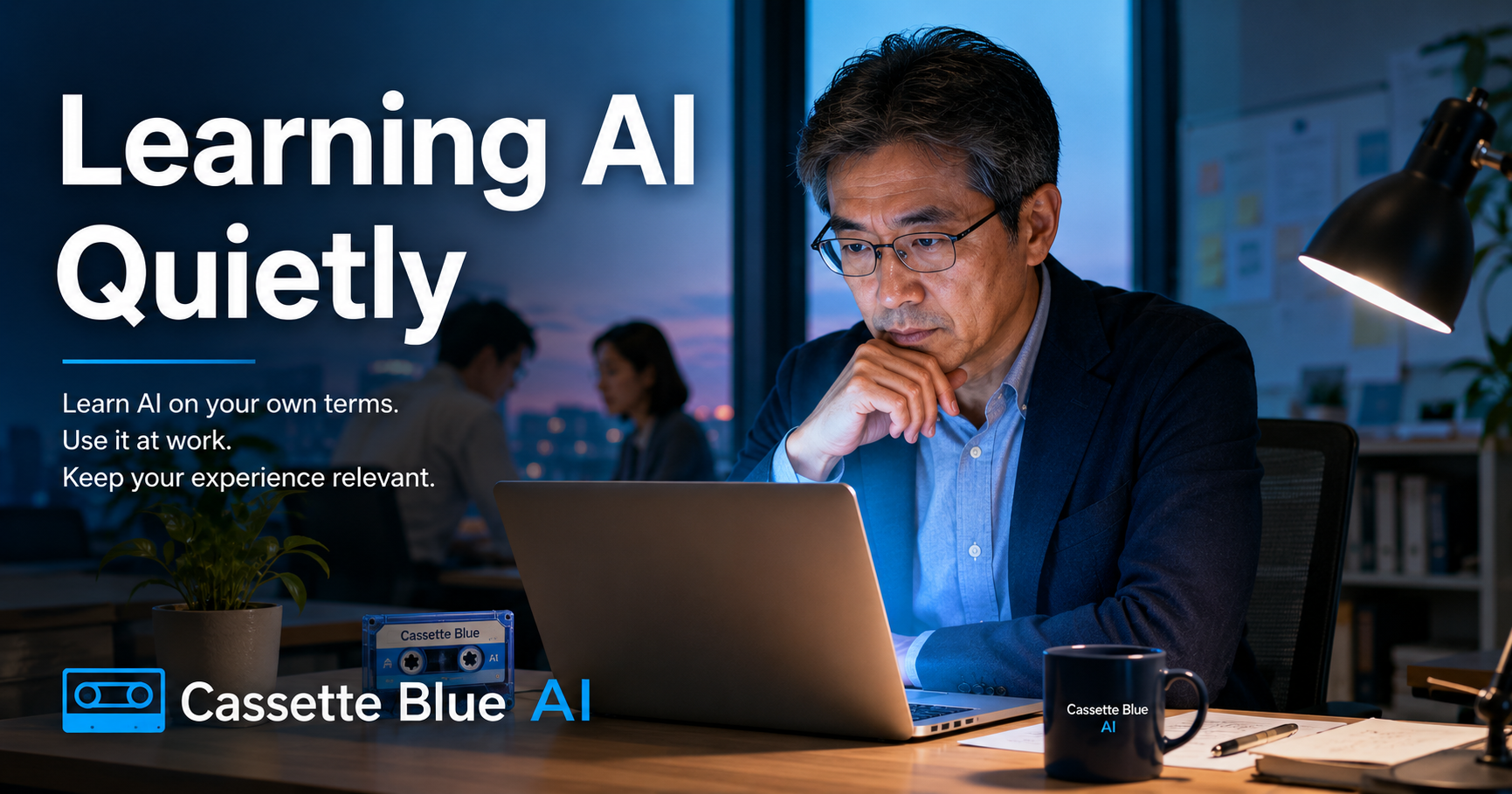
I am a Japanese company employee in my 50s.
I have spent many years working with customers, colleagues, deadlines, problems, and responsibility.
But I did not grow up with AI.
When generative AI began appearing in the workplace, younger people seemed to understand it naturally.
They knew the names of the tools.
They understood the new terminology.
They appeared comfortable experimenting in public.
I was interested too.
But I did not always feel comfortable asking a younger colleague a basic question.
As an experienced employee, I was supposed to be the person who understood the work.
I did not want my lack of knowledge about AI to make my years of experience look less valuable.
So I began learning quietly.
- The Question I Did Not Want to Ask at Work
- I Did Not Want to Become an AI Expert
- AI Became the Place Where I Could Ask Basic Questions
- My Experience Was Still Useful
- I Started with Work I Already Understood
- Learning Quietly Does Not Mean Hiding Forever
- Be Careful with Workplace Information
- A Structured Course May Make Learning Easier
- You Are Not Too Late
The Question I Did Not Want to Ask at Work
The difficult part was not only understanding the technology.
It was admitting that I did not know where to begin.
In a Japanese workplace, experience and hierarchy can matter greatly.
Older employees may be expected to guide younger colleagues.
Managers may be expected to appear calm and informed.
Asking a younger employee to explain a basic AI term can feel uncomfortable.
You may wonder what that person will think.
Will they believe you are falling behind?
Will they begin to question your ability?
Will they see your experience as outdated?
These concerns may not be unique to Japan.
Experienced professionals in many countries may feel the same pressure.
You may be comfortable asking questions about your own field.
But asking a basic question about a new technology can feel different.
I Did Not Want to Become an AI Expert
I was not trying to become a programmer.
I did not want to start my career again.
I did not want to compete with people who had studied technology for years.
I simply wanted to understand whether AI could help with the work I was already doing.
Could it help me organize my thoughts?
Could it improve the first draft of an email?
Could it summarize information before a meeting?
Could it help me research an unfamiliar subject?
These were ordinary workplace tasks.
I already understood the purpose of the work.
I only needed to learn how a new tool could support it.
That changed the way I thought about AI.
I was not beginning from zero.
I was adding a new tool to years of existing experience.
AI Became the Place Where I Could Ask Basic Questions
One of the first things I discovered was that AI did not care how basic my question was.
It did not become impatient.
It did not laugh.
It did not compare me with a younger colleague.
I could ask:
“Explain this in simpler language.”
“Show me an example.”
“What does this term mean?”
“Explain it again in a different way.”
I could repeat the same question until I understood.
That privacy made learning easier.
At work, people often try to protect their professional image.
With AI, I did not need to pretend.
I could make mistakes without being watched.
I could learn before showing anyone what I had learned.
My Experience Was Still Useful
At first, I assumed that younger people had a natural advantage with AI.
They often learn new interfaces quickly.
They may be more willing to test unfamiliar tools.
But speed is not the same as judgment.
AI can create an answer in seconds.
That does not mean the answer is useful.
It may misunderstand the situation.
It may use an inappropriate tone.
It may include incorrect information.
Years of work experience help you recognize these problems.
You understand how customers may react.
You understand workplace relationships.
You understand that a technically correct answer may still be a poor business decision.
AI can produce information.
An experienced professional must decide what deserves to be used.
That is where experience becomes an advantage.
I Started with Work I Already Understood
I did not try to learn every AI tool.
I chose a task I already knew well.
I used AI to improve the first draft of an email.
Then I compared the result with my own version.
Some sentences were clearer.
Others sounded unnatural.
The AI did not fully understand the relationship between me and the recipient.
I changed the tone, corrected the details, and removed language I would never use.
The result was not created by AI alone.
It was created by combining AI’s speed with my judgment.
That became my basic method:
- Let AI help with preparation
- Review everything using professional experience
- Keep responsibility for the final result
I later used the same method for summaries, meeting preparation, research, and organizing ideas.
Learning Quietly Does Not Mean Hiding Forever
I did not begin by announcing that I was learning AI.
I began privately because that was the easiest way to start.
There is nothing wrong with learning quietly.
You do not need to tell your colleagues that you feel behind.
You do not need to discuss every mistake.
You can practise until the tool feels familiar.
Eventually, the results may become visible.
Your emails may become clearer.
Your preparation may become faster.
Your ideas may become better organized.
People do not need to see every step of the learning process.
They will see the quality of the work.
Be Careful with Workplace Information
AI can be useful, but it must be used responsibly.
Do not enter confidential company information into a public AI tool without understanding your employer’s rules.
Do not include private customer information.
Do not assume that every answer is accurate.
Important facts must be checked.
Professional decisions still belong to the person using the tool.
AI can become a work partner.
It should not become the person responsible for your work.
This is especially important for experienced professionals.
Responsibility is part of the value we bring.
A Structured Course May Make Learning Easier
Experimenting alone is a useful beginning.
However, online information can quickly become confusing.
One article recommends a tool.
Another says the same tool is already outdated.
Videos often assume that the viewer understands basic terminology.
A structured beginner course can provide a clearer path.
You can explore beginner-friendly AI courses for experienced professionals who want a more structured way to learn.
For someone like me, a useful course should:
- Be understandable without programming experience
- Use practical workplace examples
- Allow learning at an individual pace
- Explain important ideas without unnecessary jargon
The purpose is not to collect certificates.
The purpose is to gain enough understanding and confidence to use AI responsibly in real work.
You Are Not Too Late
You may not have grown up with AI.
Neither did I.
You may not want to ask younger colleagues basic questions.
I understand that feeling.
But you do not have to choose between protecting your experience and learning something new.
You can begin privately.
You can choose one familiar task.
You can ask simple questions.
You can make mistakes without being watched.
Your experience has not become worthless because technology changed.
AI still needs context, judgment, responsibility, and an understanding of people.
Those are things experienced professionals already have.
You are not starting your career again.
You are learning how to carry your experience into a different kind of workplace.
Learn AI privately.
Use it practically.
Keep your experience relevant.
To learn more about the person behind this site, read the story of Cassette Blue.
To learn more about the person behind this site, read the story of Cassette Blue.
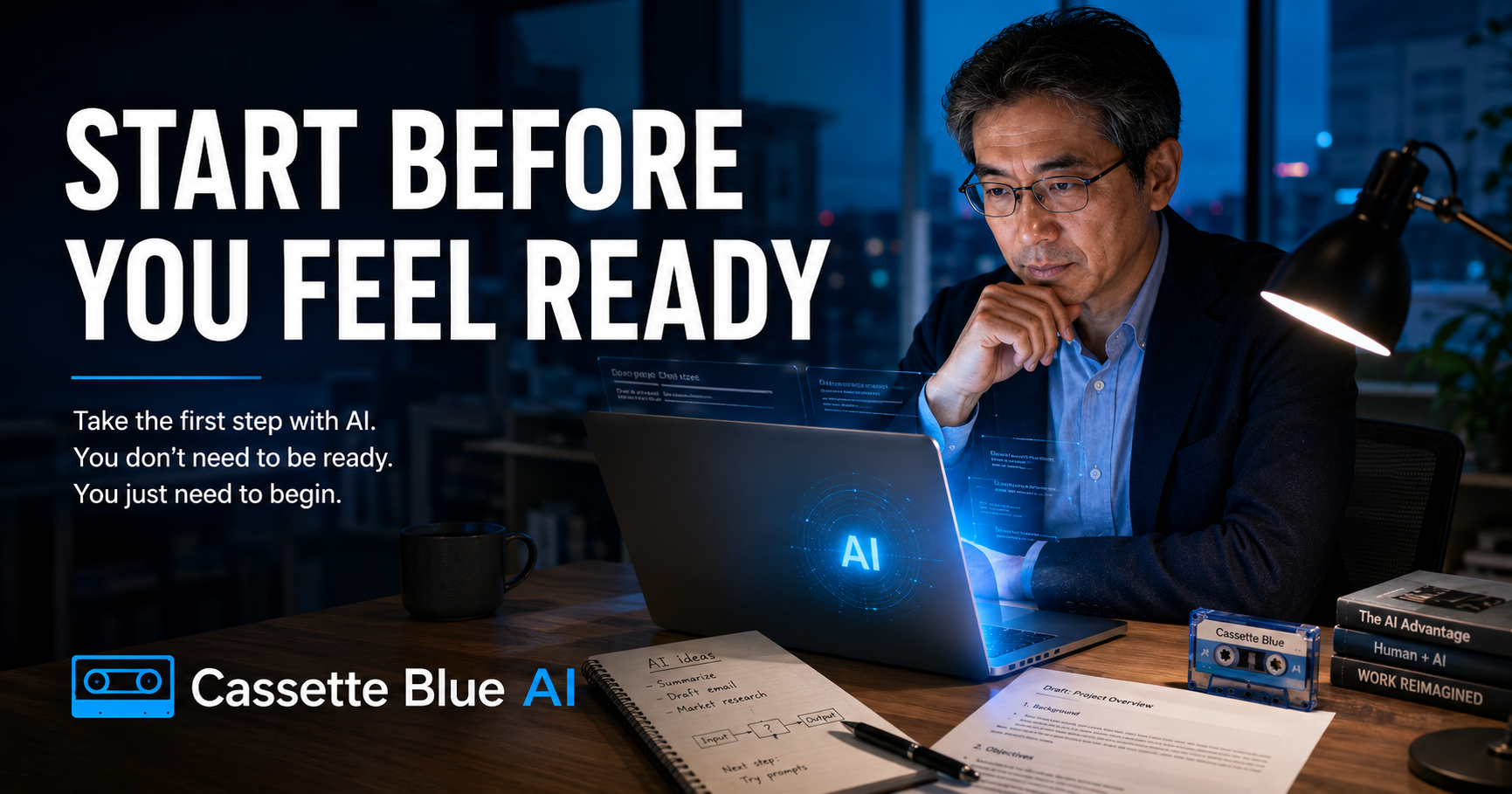
For your next small step, read why you do not need to wait until you fully understand AI.
コメント