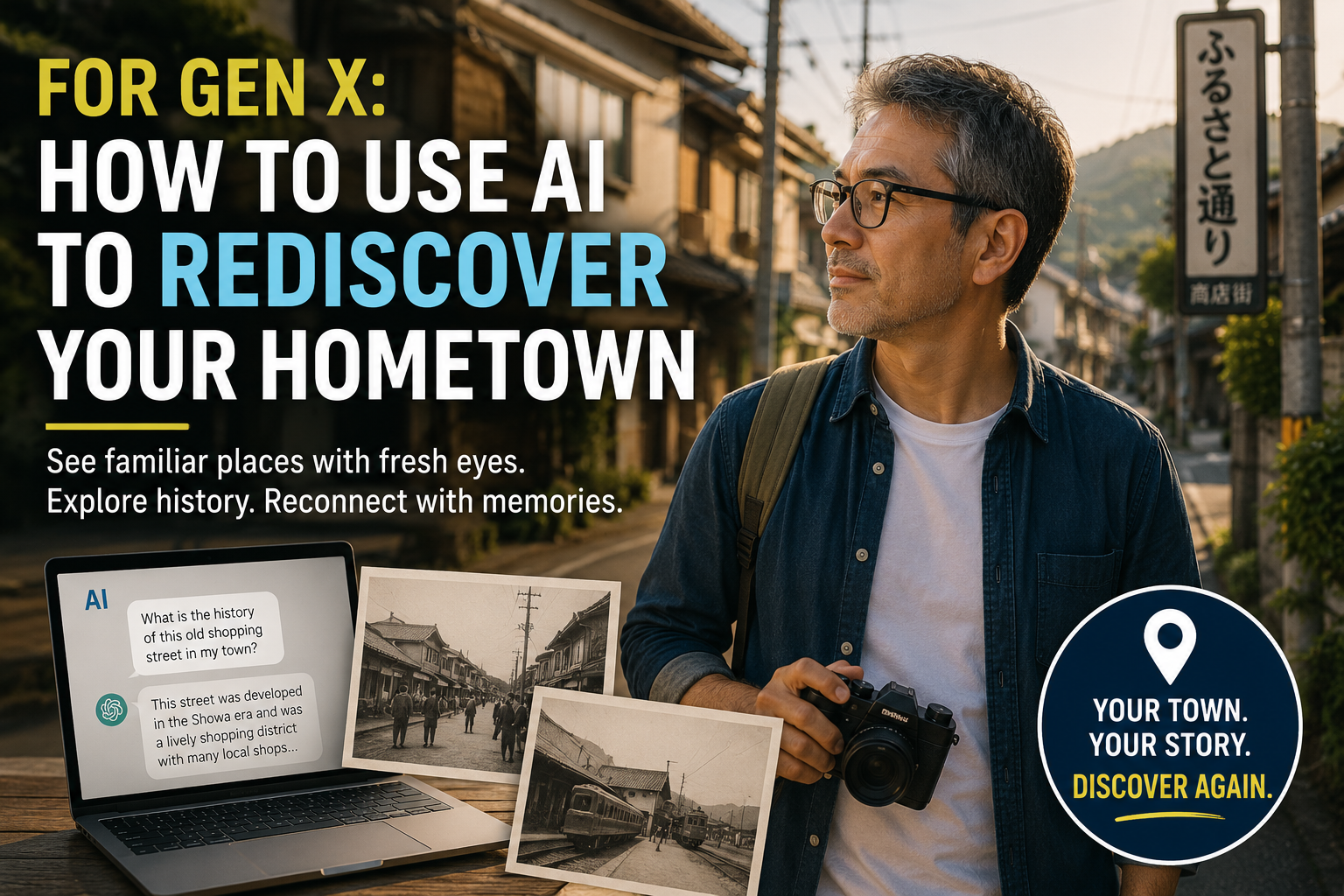
Gen X can use AI to rediscover a hometown, explore local history, and see familiar streets with fresh eyes.
When we live in the same place for many years, the scenery gradually becomes part of the background.
The road we use every day.
A shop that has been there for decades.
A station, harbour, bridge, or old building we have seen hundreds of times.
We stop asking why these places exist or how they have changed.
But a few questions to AI can make a familiar place look different.
When was this road built?
What kind of work supported this town in the past?
Why did a building I remember from childhood disappear?
AI is not only a tool for planning trips to distant destinations.
It can also become a guide that helps us rediscover the place where we already live.
- Why We Know Less About Our Hometowns Than We Think
- Use Childhood Memories to Explore Local History
- Turn an Ordinary Walk Into a Local Adventure
- Connect Old Photographs With the Present
- Share a Japanese Perspective Without Turning Japan Into a Theme
- Ask AI Better Questions About Familiar Places
- Verify Local Information Carefully
- Familiar Places Hold Part of Our Own Story
- Create a Simple Hometown Project With AI
- Rediscover One Familiar Place This Week
Why We Know Less About Our Hometowns Than We Think
We may know a surprising amount about famous places overseas.
We see them in films, documentaries, books, and travel videos.
But we may know very little about the history of our own town.
As a Gen X professional living in Japan, I sometimes find this strange.
I may know the story behind a famous building in another country, but not why an old road in my own area follows a particular route.
Living somewhere for a long time does not necessarily mean understanding it.
AI can help us find questions we would not normally think to ask.
You could begin with:
I have lived in this area for many years. Tell me some aspects of its history, geography, or industries that long-term residents might not know.
The first answer may only provide a general overview.
Choose one detail that interests you and ask a more specific question.
The purpose is not to learn everything about your hometown.
It is to find one reason to look at it again.
Use Childhood Memories to Explore Local History
You do not need to know an exact place name or date before you begin.
A memory is enough.
You might remember a small railway station that no longer exists.
A factory that once employed many people.
A cinema, market, or shop that disappeared years ago.
You can describe what you remember:
When I was a child, there was a small railway station in this area, but it has now disappeared. What are some common reasons rural stations close?
AI may not be able to identify the exact station.
But it can suggest useful areas to investigate.
Population change.
The rise of private cars.
Changes in local industries.
New roads and transport systems.
Those ideas can guide you toward municipal records, historical newspapers, old maps, and local museums.
A vague memory begins to connect with a larger story.
AI does not prove that your memory is correct.
It helps turn a memory into a question you can investigate.
Turn an Ordinary Walk Into a Local Adventure
Travel usually requires time, money, and planning.
Rediscovering your own town may require only thirty minutes.
You can ask AI:
I want to take a thirty-minute walk in my local area. Give me one theme that will help me notice its history, architecture, or natural environment.
The theme might be old buildings.
Changes in street names.
Signs of former industries.
The relationship between the town and a nearby river, railway, or harbour.
You do not need to follow the suggestion exactly.
The value comes from walking with one question in mind.
A road you have ignored for years may suddenly become interesting.
A short local-history walk can also become a small personal project that you continue over several weekends.
Connect Old Photographs With the Present
Many Gen X families still have boxes or albums filled with old photographs.
Family gatherings.
A former home.
A shop or building that no longer exists.
Sometimes we do not know exactly when or where a photograph was taken.
AI can help you identify what to examine.
You could say:
This photograph may have been taken in a small Japanese town during the 1980s. Help me list the details I should examine to estimate the period and understand the location.
AI might suggest looking at:
The cars.
Road signs.
Clothing.
Building materials.
Advertising.
Utility poles or street design.
You should not use AI alone to confirm the place or date.
But it can show you which details may be useful.
You can then ask family members, compare old maps, or search local archives.
One photograph may begin a conversation that would not otherwise have happened.
It may also help you rediscover an old interest in photography, family stories, or local history.
Share a Japanese Perspective Without Turning Japan Into a Theme
Writing about Japan for an international audience can easily become a discussion of temples, traditional culture, or famous tourist destinations.
But everyday Japan is also worth describing.
People go to work.
Old shops close.
Railway lines change.
Parents remember a version of the town that their children never saw.
These experiences are not unique to Japan.
Towns in the United States, the United Kingdom, Australia, and other countries also change as industries, populations, and lifestyles change.
My experience of living in Japan does not need to be presented as an explanation of an exotic country.
It can simply be one example of a Gen X person looking again at the place where he has spent much of his life.
The location is Japanese, but the experience of change, memory, and belonging is widely shared.
Ask AI Better Questions About Familiar Places
A broad question may produce a broad answer.
Instead of asking:
Tell me about my town.
Try asking about one specific subject.
What industries shaped this town between 1960 and 1990?
Or:
What changes should I look for when comparing an old map with the town today?
You can also ask AI to help improve your question:
I want to research the history of this neighbourhood, but I do not know where to begin. Ask me one question at a time until we find a specific topic.
This is the same process we can use when our thoughts are not yet clear.
AI helps narrow the subject before we begin searching for reliable information.
Verify Local Information Carefully
AI can make serious mistakes about local history.
It may confuse places with similar names.
It may combine events from different regions.
It may even create a convincing explanation for a place-name that has no factual basis.
Specific information should therefore be checked with reliable sources.
Useful sources may include:
Municipal websites and archives.
Libraries and museums.
Historical societies.
Official maps and planning documents.
Local newspapers.
AI should help you decide what to investigate, not provide the final authority.
You can ask:
What kind of official or local sources could confirm this information?
AI can then help you organize a research process.
Begin with a question.
Find a reliable source.
Compare what you discover with the place itself.
Use AI as the entrance, then return to real records, real people, and the real location.
Familiar Places Hold Part of Our Own Story
Exploring a town is not only about collecting historical facts.
It can help us understand our own lives.
Where did we grow up?
Which places shaped our routines?
What has disappeared?
What remains?
A familiar road may contain memories of school or work.
An old shop may remind us of time spent with family.
A building that no longer exists may represent an entire period of our lives.
In the second half of life, we do not always need to focus only on what comes next.
There is value in looking back at the places we have already passed through.
AI can help turn that reflection into curiosity rather than simple nostalgia.
Create a Simple Hometown Project With AI
You can turn local exploration into a small project without making it complicated.
Choose one street.
One old photograph.
One building.
One childhood memory.
Then ask AI to create a simple plan.
I want to learn more about one familiar place in my town. Create a four-week project that requires no more than thirty minutes each weekend.
The plan might include:
Week one: write down what you already remember.
Week two: look for an old map or official record.
Week three: visit the location and take a photograph.
Week four: write a short paragraph about what changed.
The result does not need to become a book, website, or public presentation.
It can remain a private record.
The purpose is to notice something you had stopped seeing.
Rediscover One Familiar Place This Week
You do not need to travel far.
Choose a road you use regularly.
A building you have always wondered about.
A place you remember from childhood.
Then ask AI:
I want to see a familiar place with fresh eyes. Suggest one small exploration I can complete in thirty minutes this week.
Take the suggestion outside.
Walk through the real place.
Take one photograph.
Write down one question.
When you return home, continue the conversation with AI.
Ask AI.
Check the real place.
Then learn something new about where you have already lived.
For Gen X, AI is not only a technology for the future.
It can also help us rediscover our hometowns, understand the places that shaped us, and see our own history with fresh eyes.

コメント