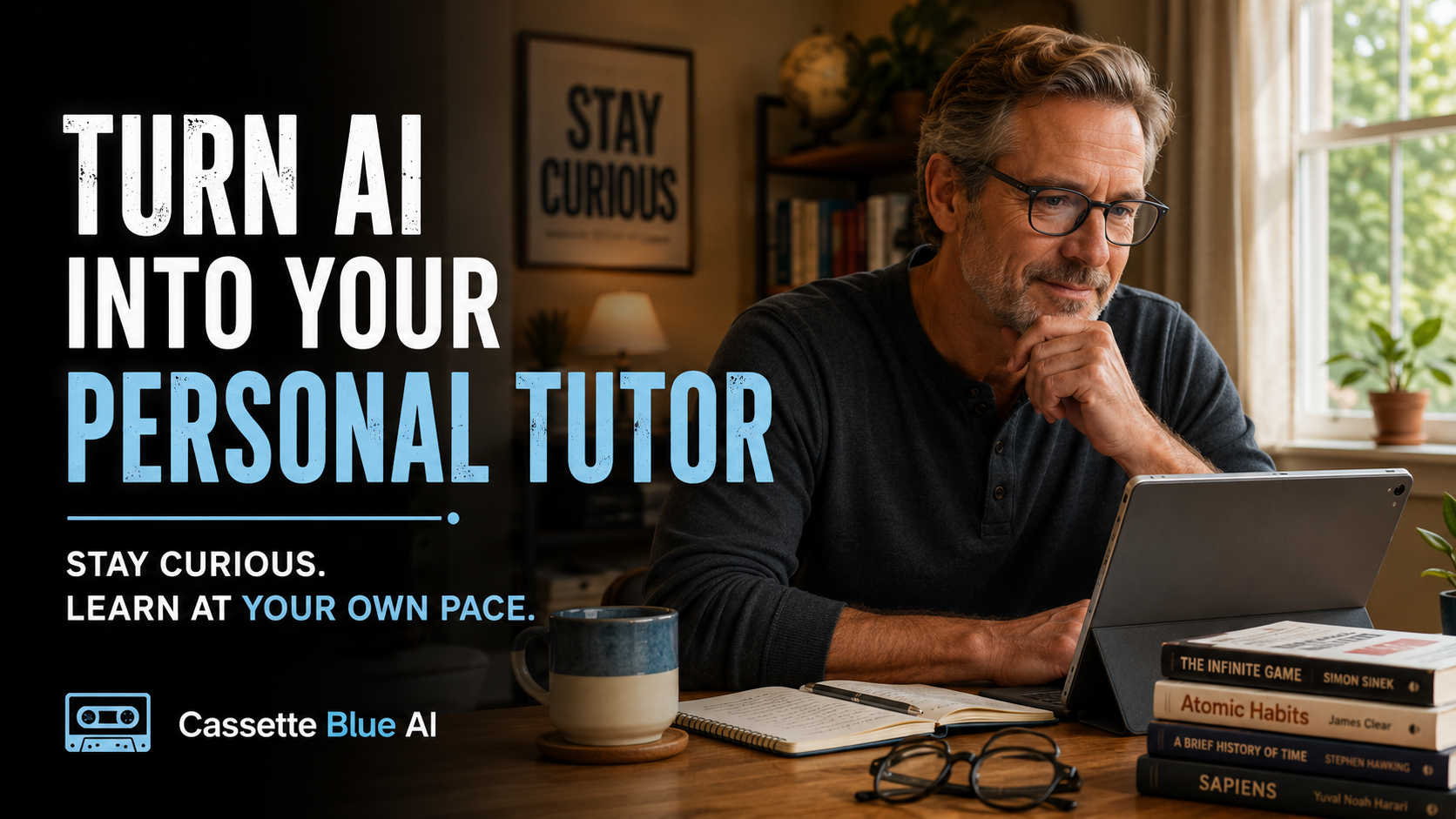
Gen X can use AI as a personal tutor to explore new interests, understand difficult subjects, and continue learning in the second half of life.
As you talk with AI, you may begin to notice what you want to learn.
A conversation about travel may make you curious about another country’s history.
Looking through old photographs may make you want to take pictures again.
We do not always know what we want to learn before we begin.
Sometimes, curiosity appears during an ordinary conversation.
When that happens, AI can move from being a conversation partner to becoming a personal tutor.
Not for an exam.
Not to impress anyone.
But to make the next part of life more interesting.
Why Learning Can Feel Harder After 50
In our 50s, it can feel harder to learn something new.
But that does not necessarily mean we have lost the ability to learn.
We have work.
We have family responsibilities.
By the end of the day, both our minds and bodies may be tired.
Perhaps the real difficulty is not our age.
Perhaps it has simply become harder to spend several uninterrupted hours studying.
Gen X has already learned many technologies as adults.
We learned computers, the internet, mobile phones, and smartphones.
We did not understand them immediately.
We learned what we needed, one step at a time, and gradually made them part of everyday life.
We learned mobile phones as adults, and we can learn AI in the same way.
AI now gives us another advantage.
It can adjust an explanation to our time, interests, and level of understanding.
How to Use AI as a Personal Tutor
When reading a book or watching a video, there may be a point where the explanation suddenly stops making sense.
An unfamiliar term appears.
Some background knowledge is missing.
But you may not know how far back you need to go.
You can tell AI exactly what happened.
I stopped understanding at this point. Please explain it from the beginning for someone in their 50s with no specialist knowledge.
If the explanation is still too difficult, ask AI to simplify it again.
Ask for an everyday comparison.
Explain the idea in your own words and ask whether your understanding is correct.
When speaking to another person, we may feel uncomfortable asking the same question several times.
With AI, you can return to the point you understand and begin again as often as necessary.
That is one of the most useful ways to use AI as a personal tutor.
Learn According to Your Own Interests
School subjects usually follow a fixed order.
Most learning materials are also designed for a broad audience.
But learning in the second half of life can be more flexible.
You do not need to become fluent in English.
Perhaps you only want enough English to enjoy a short conversation while traveling.
You do not need to become a professional photographer.
Perhaps you simply want to take better photographs during your walks.
You could ask AI:
I studied English at school, but I have not used it for many years. Teach me something I can learn in ten minutes today that will help me enjoy traveling abroad.
When you explain your goal and the time you have available, AI can adjust the lesson to suit you.
The most important thing is not finding the perfect learning method.
It is finding a way of learning that you can enjoy and continue.
AI can also help you rediscover an old interest and find a small way to begin again.
Use AI as a Practice Partner
AI does more than explain things.
It can also help you practise.
For English, it can become a simple conversation partner.
For history, it can ask questions to check what you understood.
After learning something, you can explain it in your own words and ask:
Is my understanding correct? Please correct only the parts I have misunderstood, and keep the explanation simple.
When we only read, it is easy to believe we understand more than we actually do.
When we explain an idea and answer questions, the gaps become easier to see.
AI can repeat that process without becoming impatient.
It can ask easier questions first and gradually make them more difficult.
It can also create a short review based on what you learned yesterday.
This turns AI from a source of information into an active learning partner.
Ten Minutes a Day Is Enough
When beginning something new, we often create an ambitious plan.
Study for one hour every day.
Understand an entire subject within three months.
Aim for a major result from the beginning.
But when the plan becomes a burden, learning itself can stop being enjoyable.
Ten minutes a day may be enough at first.
You can tell AI:
I am a complete beginner. Teach me one thing I can enjoy and understand in ten minutes today.
Once you understand one thing, another question may appear.
You can return the next day and continue.
There is no deadline for learning that makes your life richer.
You do not need to compete with anyone.
You can continue at your own pace.
Apply What You Learn in Everyday Life
Learning can become difficult to continue when it remains only inside a book or screen.
Even a small practical use can make it more enjoyable.
After learning English, listen for one short sentence in a favourite movie.
After learning about photography, take one picture during your next walk.
You can also ask AI:
Give me one simple way to use what I learned today in my life this week.
When learning becomes connected to everyday life, knowledge begins to feel like your own.
It may not look like a major achievement.
But the world may begin to look slightly different from how it did yesterday.
That small change is important.
The purpose is not always to gain a qualification, change careers, or prove something to other people.
Sometimes, learning is valuable because it makes an ordinary day more interesting.
Check Important AI Answers
AI is useful, but it can also make mistakes.
It may use outdated information.
It may explain something inaccurately.
It may even present information that does not exist.
Important facts should therefore be checked using official sources, reliable books, or trusted experts.
You do not need to learn everything from AI.
AI can simplify difficult language.
It can explain the overall picture.
It can help you discover what you want to learn next.
When your interest becomes deeper, you can move on to books, structured courses, or lessons created by specialists.
AI is not the whole learning process.
It is an easy place to begin and a guide when you are unsure where to go next.
Learning After 50 Can Be for You
When we were younger, learning usually had a clear purpose.
Pass an exam.
Find a job.
Gain approval from other people.
In our 50s, we can learn for ourselves.
We may want to speak briefly with someone from another country.
We may want to understand a subject that has always interested us.
Something we did not understand yesterday may become a little clearer today.
That alone can expand our world.
Learning does not always have to produce a certificate, promotion, or measurable result.
It can also be a way to keep the second half of life interesting.
Talk First, Then Learn With AI
You do not need to choose a subject before you begin.
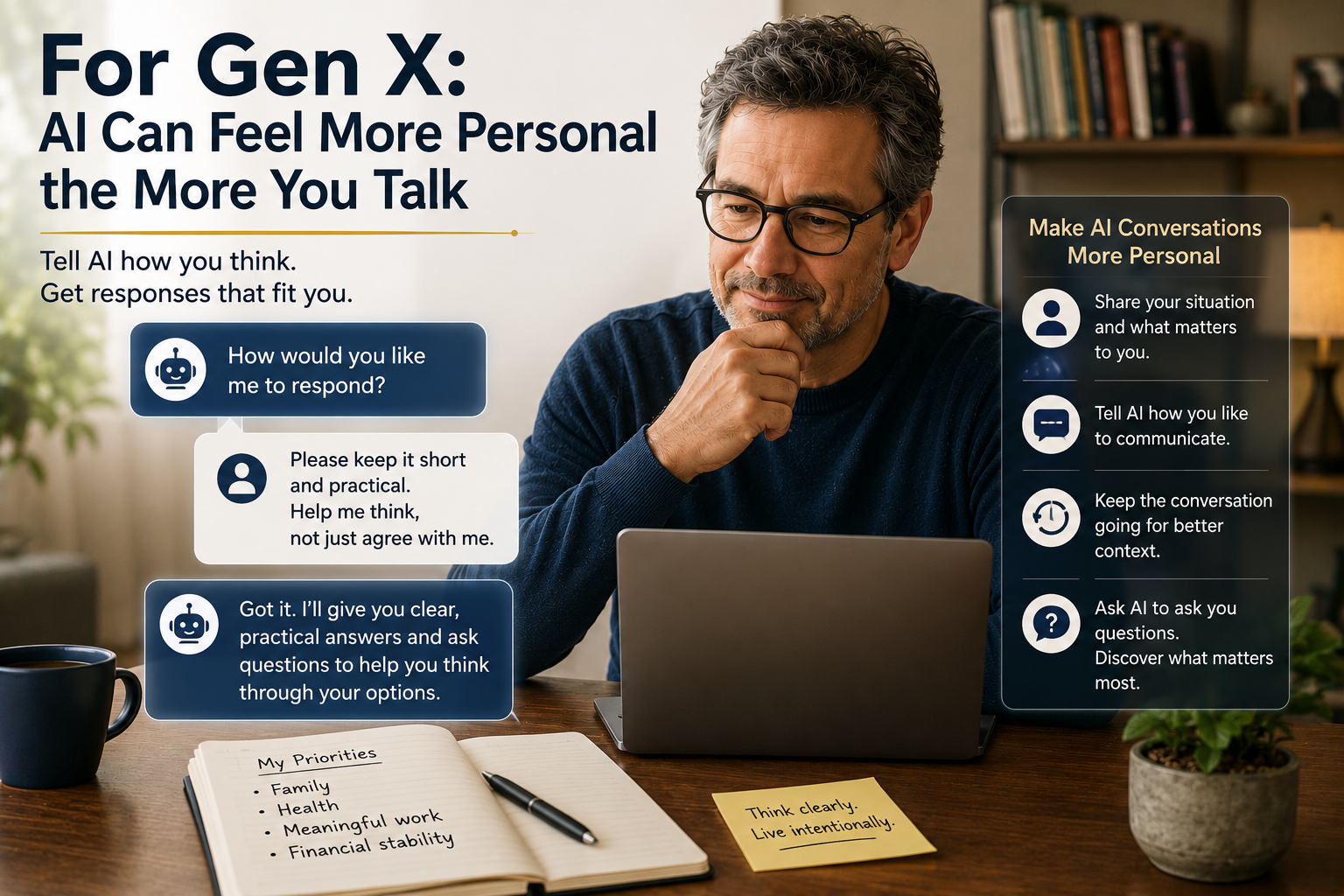
Start by talking with AI.
Describe something that has recently caught your attention.
Remember something you once enjoyed.
Notice which part makes you want to know more.
Then ask AI to teach you.
You could begin with this:
Based on our recent conversations, suggest one thing I might enjoy learning now. Teach me only the first ten minutes.
AI cannot completely replace a human teacher.
But it is available when curiosity appears.
It can return to the point where you became confused.
It can practise with you as many times as you need.
First, talk with AI.
When you discover what you want to know, learn with AI.
For Gen X, AI is not only a tool for working faster.
It can also become a personal tutor that helps us remain curious, learn at our own pace, and continue expanding our world in the second half of life.
コメント