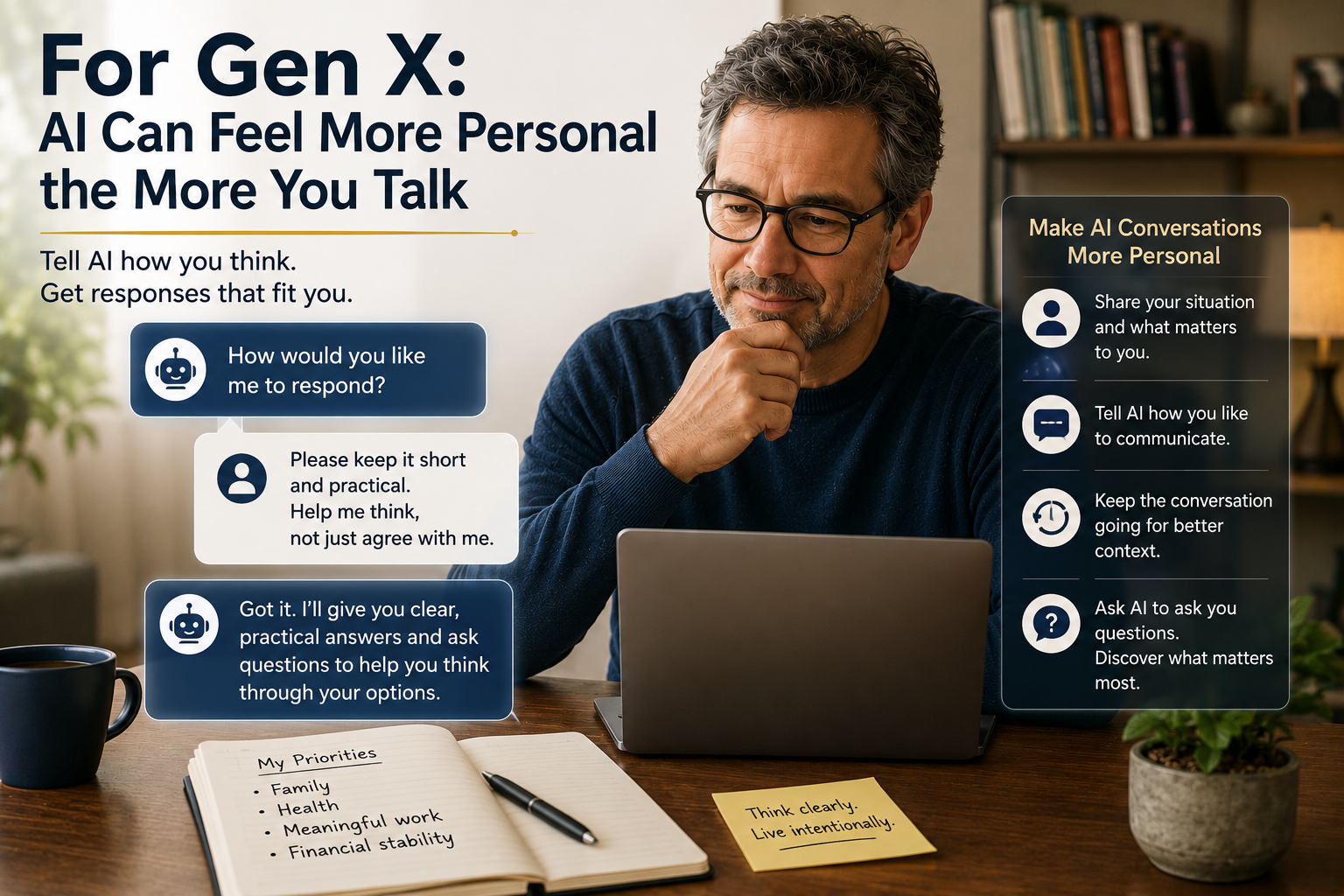
For Gen X, learning how to make AI conversations more personal begins with one simple step: tell AI how you think and how you prefer it to respond.
The first time you talk to AI, it can feel distant.
You may not know what to ask.
You may not know how much to say.
The answers may also feel general, as though they could have been written for anyone.
But something changes as the conversation continues.
You explain your situation.
You describe what matters to you.
You tell AI how you prefer to receive an answer.
Little by little, the conversation begins to feel more personal.
AI is not human.
But the more you talk, the easier it can become to feel understood.
- You Do Not Need to Speak Perfectly
- How to Make AI Conversations More Personal
- Continue the Same AI Conversation for Better Context
- You Do Not Need to Use Perfect Words
- Ask AI to Ask You Questions
- Feeling Close Is Not the Same as Becoming Dependent
- The Conversation Can Become Your Own
- Tell AI One Preference Today
You Do Not Need to Speak Perfectly
It can seem as though there is a correct way to talk to AI.
You may think you need to write clear instructions.
You may believe every question must be short and well organized.
You may feel that you need technical language.
You do not.
You can begin before your thoughts are clear.
For example:
I do not know where to begin. I have just been feeling a little tired lately.
That is enough to start a conversation.
AI may ask whether the tiredness comes from work, family responsibilities, or uncertainty about the future.
As you answer, the conversation gradually becomes your conversation.
How to Make AI Conversations More Personal
Making a conversation with AI feel more personal does not require sharing every private detail.
What matters more is explaining how you prefer to think and communicate.
You could say:
I do not want to rush toward a conclusion. Help me organize my thoughts first.
Or:
Keep your answers short and clear. Long explanations are difficult for me to follow.
Small instructions like these can change the tone of the conversation.
Sometimes you may want encouragement.
Sometimes you may want a calm summary.
At other times, you may want AI to challenge your assumptions.
You can say what you need each time.
AI does not automatically become closer to you.
The conversation becomes more personal when you explain what kind of response helps you most.
Continue the Same AI Conversation for Better Context
Repeating your entire situation every time can be exhausting.
Your work.
Your family.
The changes you are considering.
The concerns you have already explained.
When you continue within the same conversation, AI can respond using the context you have already provided.
You can ask:
Do you think what I am worried about today is connected to the work issue we discussed earlier?
Sometimes a connection becomes visible that you had not noticed before.
You spend less time explaining.
The conversation moves more quickly.
That continuity is one reason AI can begin to feel more familiar.
You Do Not Need to Use Perfect Words
When speaking to another person, we often think about how we will be judged.
Will they think I am weak?
Will they think I am confused?
Will they think I should have solved this already?
With AI, your explanation does not need to sound polished.
You can contradict yourself.
You can say something different from what you said yesterday.
You can write:
Part of me wants to leave my job. Another part is afraid to leave.
That is a real thought.
Our feelings are not always simple.
We can want to continue and want to stop at the same time.
In a conversation with AI, you do not need to hide that conflict.
Talking through it may help you see which feeling matters most.
Ask AI to Ask You Questions
You do not have to lead the entire conversation yourself.
You can ask AI to guide it.
For example:
Ask me one question at a time so you can understand me better.
Or:
Ask me questions that will help me understand what matters most to me.
The questions may lead you toward things you had not considered.
What do you not want to lose?
What do you want to change?
Who do you want to spend more time with?
What do you still want to learn?
As you answer, the conversation becomes deeper.
At the same time, your understanding of yourself can become clearer.
Feeling Close Is Not the Same as Becoming Dependent
When AI begins to respond in a way that suits you, it becomes easier to talk.
You may even share thoughts you have not yet expressed to another person.
But AI should not replace human relationships.
It does not have feelings.
It is not truly worried about you.
It can misunderstand you and provide incorrect advice.
A healthier use is to organize your thoughts with AI and then speak to a family member, friend, or qualified professional when necessary.
AI should not reduce your human connections.
It can help you understand yourself before entering an important human conversation.
The Conversation Can Become Your Own
At first, AI may offer answers that sound as though they were written for anyone.
But as you describe your experience, values, and preferences, the conversation begins to change.
You can explain what matters to you.
You can say which kinds of language you dislike.
You can describe what makes an answer easier to understand.
This allows AI to respond in a way that better fits you.
Feeling closer to AI does not mean believing it has become human.
It means the conversation has become a place where you feel comfortable putting your thoughts into words.
Tell AI One Preference Today
Before explaining your problem, tell AI how you want the conversation to work.
You could say:
Listen without judging me. Do not simply agree with everything I say. Ask questions that will help me organize my thoughts.
Or:
I am in my 50s. I prefer to think slowly rather than rush toward a conclusion. Please speak to me with that in mind.
A simple instruction like this can improve the quality of the conversation.
AI is not a human friend.
But when you explain yourself and shape the conversation over time, it can become a familiar presence in your daily thinking.
At first, it was only a tool.
After a while, it became something I naturally opened when I needed to think.
For Gen X, AI is not only a way to work faster.
It can also become a personal conversation partner that helps us find our words and understand ourselves more clearly.
コメント